

Buying a portable scoreboard is not only about choosing a light cabinet. The system must move through the venue, connect safely to power, support the game-day workflow, remain readable from the required seats, and return to storage after the event.
A manual flip board may suit a small practice court. A tabletop electronic unit may work in a school gym. A field setup may need a larger LED display, wheeled support, remote control, weather protection, and a clear power plan. Each setup calls for a different combination of display, support, controller, power, transport, and storage.
This guide compares portable scoreboard types, explains what to include in a supplier RFQ, and shows when a standard model or a customized configuration may fit the venue.
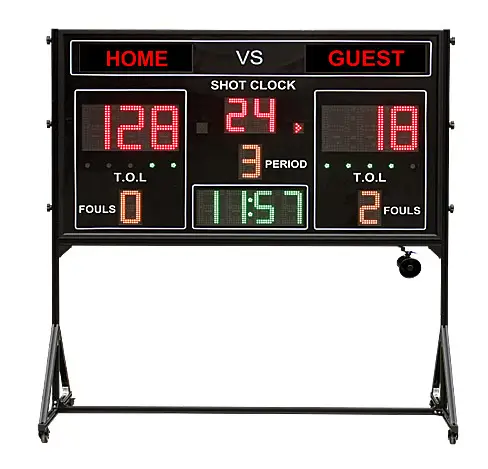
What Does “Portable” Mean in a Real Venue?
A scoreboard is portable only when staff can move it, set it up, operate it, and store it safely. A display may be light enough for one person to lift but still be difficult to use if the cart cannot pass through a door, the controller has no protected operating position, or the venue needs a different power connection at every event.
Portable does not always mean handheld. It can describe a tabletop unit, a wheeled scoreboard, a temporary support frame, or a modular system that packs into cases between events.
Check the complete route from storage to the playing area. Measure doors, turns, lift openings, vehicle access, and the final setup position before you compare display specifications.
The table below shows common portable scoreboard setups and the conditions that usually determine whether each one works.
Portable setup | Typical use | What usually decides whether it works |
|---|---|---|
Manual flip or card board | Practice, casual play, backup scoring | Number size, two-sided visibility, wind security, and operator convenience |
Tabletop electronic unit | Indoor school or club courts | Viewing distance, control simplicity, outlet location, and storage case |
Wheeled indoor scoreboard | One facility with several courts | Door and lift clearance, cart stability, cable management, and setup crew |
Venue-to-venue LED system | Tournaments and traveling teams | Packed size, lifting points, vehicle restraints, power, and repeatable setup |
Temporary outdoor system | Fields, event grounds, and seasonal venues | Sunlight, weather exposure, ground support, wind, cable protection, and battery or AC planning |
Before comparing models, measure the narrowest door, tightest turn, lift opening, vehicle access point, and storage location. Then record the crew size and the time available for setup. Those details often eliminate unsuitable systems before display specifications become relevant.

Should You Buy a Manual, Electronic, or LED Scoreboard?
Choose the display according to the sport, viewing distance, required fields, setup crew, and available power. Manual boards reduce power and electronics. Electronic LED systems improve visibility, timing, and sport-specific information, but they also require a broader plan for support, control, transport, and storage.
Manual flip boards work when the operator stands close to the board and the event does not require a clock, horn, fouls, periods, or other live fields. They can serve as a primary board for small venues or as a backup during electronic scoreboard maintenance.
Electronic tabletop boards suit gyms that need a readable score and clock but have limited storage and no permanent installation point. Confirm that the quotation includes the controller, horn, power adapter, carry case, and fields required by the sport.
LED systems are a stronger fit when spectators sit farther away, the venue hosts several sports, or sunlight and outdoor conditions affect readability. For a broader view of how LED displays support live sports presentation, see how LED scoreboards enhance the sports viewing experience. The quote may also need to include support hardware, controller modes, communication, power distribution, transport protection, delivery, installation, commissioning, and spare parts.
Compare the setup your staff can move, power, operate, and store reliably at the venue. Display type alone does not determine whether the system will work on game day.

How Do Indoor, Outdoor, and Mixed-Use Requirements Differ?
Indoor and outdoor scoreboards face different operating conditions and environmental challenges. Indoor units still need to handle glare, ball impact, crowded sidelines, cable traffic, and limited storage. Outdoor systems add direct sunlight, wind, rain, dust, temperature changes, uneven ground, and longer viewing distances.
For North American projects, UL’s sign-location guidance distinguishes dry, damp, and wet sign locations. Use this document as a reference when defining the intended environment. Confirm the applicable certification and marking for the selected display, controller, connectors, and power components in the project quotation.
A mixed-use system needs a written configuration for both environments. Ask the supplier to state which components are intended for indoor use, which are intended for outdoor use, what protection is required for temporary deployment, and how the system should be stored after exposure to moisture. A display may be weather-rated while its controller, extension cable, support frame, or battery charger is not.


Which Sports Fields and Controls Do You Actually Need?
Sport mode should be evaluated as a display-and-controller combination. The score is only one part of the operating workflow. Depending on the sport, the operator may also need to manage time, periods, fouls, sets, innings, possession, horns, timeouts, or competition status.
Sport | Fields to confirm | Questions that affect the purchase |
|---|---|---|
Basketball | Score, game clock, period, fouls, possession, horn, and shot clock where required | Can the operator correct a score quickly? Can the quoted layout show every field from the main viewing angle? |
Volleyball | Points, sets, serving team, timeouts, and match status | Does the controller support set changes and service indication without workarounds? |
Wrestling | Scores, match clock, period, and competition status | Can the operator recover from an incorrect entry during a live match? |
Soccer | Team scores, match clock, and half or period | Can the clock follow the venue’s competition procedure? |
Baseball or softball | Runs, inning, ball, strike, and out | Are the smaller fields still readable at the intended distance? |
American football | Scores, clock, quarter, down, distance, and timeouts | Are separate play clocks required, and are they included in the same control workflow? |
NFHS scorer and timer materials separate the official score, game clock, audible signal, and backup timing. The FIVB Official Volleyball Rules describe a different information structure built around points, sets, substitutions, Libero activity, match records, and scorer duties. Ask the supplier to demonstrate every sport mode you plan to use and confirm the required fields and correction steps.


How Large Should the Display Be?
Choose the display size from the farthest person who must read the primary fields. Then check side viewing angles, glare, and obstructions. Cabinet dimensions alone do not show whether the score, clock, and period will remain readable in the actual venue.
Give the supplier the farthest viewing position, main side viewing angles, glare direction, obstructions, and the fields that need the largest digits. If players and spectators view opposite sides, confirm whether a two-sided display is required. Ask for a full-size digit sample or a viewing-distance recommendation based on the proposed layout rather than a generic “indoor” or “outdoor” label.
Put the agreed digit height, layout, brightness setting, and viewing distance in the quotation. This reduces the risk of receiving the quoted cabinet while the venue expected a different reading distance or field size.

What Should the Controller and Power Plan Include?
The controller should let the assigned operator select the sport, start and stop the clock, correct a score, change the period, activate the horn, and recover after a wrong entry or power interruption. During a demonstration, test startup, sport selection, score correction, clock start and stop, period or inning changes, horn operation, brightness or display control where applicable, and recovery after an incorrect entry.
Wireless control and battery power solve different problems. Wireless describes the data link between the operator and display. It does not mean that the display is self-powered. Ask for the display power source, controller power source, charging interval, expected runtime, low-power warning, operating range, data-loss behavior, and power-loss recovery separately.
Comsight’s scoreboard controller box is a standard controller option. Confirm its compatibility with the selected display, sport modes, communication method, and site power arrangement in the quotation. For a temporary outdoor event, also ask who supplies protected cable routing, backup power, and the restart procedure after an interruption.

How Do You Move, Set Up, and Store It Safely?
The transport solution should be designed around the people who will use it. Confirm packed dimensions, total weight, handles, wheels, lifting points, cases, vehicle restraints, setup time, and the number of people required for each step.
For outdoor deployment, add ground condition, wind exposure, support stability, cable protection, and rain response to the checklist. A wheeled cabinet that is easy to move on a gym floor may need a different support method on grass or soft ground. If the board moves between venues every week, ask which parts are most vulnerable to impact and whether replacement modules or spare cables are available.
Storage is part of the purchase. Reserve space for the display, controller, support hardware, cases, cables, chargers, and spare parts. Define how equipment should be dried, inspected, and packed after an outdoor event.
How Should You Compare Portable Scoreboard Quotes?
Compare everything required to run the scoreboard at the venue: display, controller, stand or cart, power equipment, cables, wireless link, delivery, installation, testing, training, warranty, and spare parts.
Two cabinets with similar dimensions can have different prices because one quotation includes support, outdoor protection, wireless communication, battery equipment, delivery, installation, commissioning, training, warranty, and spares while the other does not.
Ask each supplier to mark the following as included, optional, or excluded:
- Display cabinet, digit size, layout, and brightness;
- Controller, sport modes, horn, timer, and communication method;
- Stand, cart, frame, anchors, cases, and transport protection;
- Power supply, charger, battery, cable protection, and backup method;
- Delivery, installation, testing, training, manuals, warranty, and spare parts.
The same comparison principle applies to portable systems: evaluate the scope that makes the scoreboard usable, not only the cabinet price.

What Should You Send in a Portable Scoreboard RFQ?
Give every supplier the same brief. Include the venue type, indoor or outdoor conditions, sports and competition level, required fields, viewing distances, difficult light, display sides, movement route, door and vehicle limits, setup crew, power access, controller preference, support method, storage space, accessories, service expectations, budget scope, and acceptance tests.
Attach site photographs, a simple plan, the proposed display position, route measurements, and any league or school requirements. State whether you are comparing a standard product, a temporary deployment, or a project configuration. This helps a supplier recommend the right product family instead of guessing from “portable scoreboard” alone.
Which Comsight Scoreboard Should You Consider?
Comsight provides LED scoreboard solutions for different sports and venue requirements, including configurations for portable or temporary applications. Depending on the project, the display can be configured with suitable support, transport, power, and control solutions.
The LED scoreboard range can be a starting point when the sport, viewing distance, and required fields are already clear. The multi-functional scoreboard range may be a better fit when one venue runs several sports and the controller must support different layouts.
Customized configurations can also address display size, digit and field layout, sport modes, controller or control interface, support structure, mobile configuration, and indoor or outdoor requirements.
Send Comsight the RFQ information above and ask which standard model fits the project. Move toward a project configuration when the venue, transport, power, visibility, or sport-specific requirements call for a different setup.

Conclusion
A portable scoreboard is a complete game-day system. Choose it by matching the display, sport fields, controller, power, support, transport, and storage plan to the way your venue operates.
Use a manual or compact electronic board when the viewing distance is short and the workflow is simple. Choose a larger LED or multi-functional system when the venue needs longer viewing distance, outdoor visibility, several sports, live timing, or a defined process for selecting the sport, starting the clock, correcting scores, changing periods, sounding the horn, and resetting the display.
Before requesting a quote, document the route, viewing positions, required fields, power, storage, and acceptance tests. That brief gives suppliers enough information to recommend a standard model or identify which requirements need a separate project configuration.
Planning a portable or customized LED scoreboard? Share your sport, viewing distance, display size, required fields, and venue conditions with Comsight, and our team can help recommend a suitable configuration.
FAQs
1. What should I include in a portable scoreboard RFQ?
Include the sports, required fields, viewing distances, indoor or outdoor environment, display sides, transport route, storage limits, power source, controller preference, support method, and acceptance tests. Photos and a simple site sketch help suppliers quote a workable system instead of guessing from the sport name.
2. Do portable scoreboards need a separate stand or cart?
Some models are tabletop units, while others need a wheeled cart, temporary frame, or venue support. Ask the supplier to identify the support hardware, packed dimensions, total weight, wheel or lifting requirements, and whether those items are included in the quotation.
3. What happens if the venue has no convenient power outlet?
Ask for the complete power plan: outlet location, cable length, protection, battery option, charging time, runtime conditions, and power-loss recovery. Wireless control does not mean the display itself is battery powered.
4. How do I compare a tabletop scoreboard with a wheeled LED unit?
Compare the farthest viewing position, digit size, setup time, operator workflow, transport route, storage footprint, and required fields. The lighter unit is not automatically the better choice if viewers cannot read it or the team cannot secure it safely.
5. Which scoreboard specifications affect the quote most?
Display size, digit height, outdoor protection, support structure, controller functions, power arrangement, communication method, accessories, delivery, and installation usually affect the scope. Ask suppliers to mark each item as included, optional, or excluded so the quotes are comparable.
6. Can the same controller operate different sports?
Only when the controller, display layout, firmware or software, and communication method support those sports together. Request a written list of available sport modes and test score correction, period changes, horn operation, and recovery from an incorrect entry.
7. What should I verify before using a scoreboard outdoors?
Verify the marked environment rating, enclosure and connector protection, support stability, wind exposure, cable protection, viewing conditions, and power arrangement. Confirm the applicable certification and marking for the selected components instead of relying on an “outdoor” label alone.

