

A softball scoreboard has one job during a game: help spectators follow the score and help the operator update it without confusion. For most fields, the general layout includes HOME, GUEST, the current score, INNING, BALLS, STRIKES, and OUTS.
The right LED scoreboard depends on more than the number of fields on the face. The competition determines what must be shown. The viewing distance affects digit size. The field and support structure affect installation. The controller affects how quickly the operator can update or correct the game.
This guide follows those decisions in order, from the information a softball scoreboard should display to the layout, visibility, installation, controller, quote scope, and custom proposal.

What Does a Softball Scoreboard Need to Show?
A scoreboard should show the game information that changes during play without forcing spectators to interpret a crowded display. For most softball fields, the general configuration includes HOME, GUEST, the current score, INNING, BALLS, STRIKES, and OUTS.
Field | What it tells the audience | Why it belongs in the general layout |
HOME / GUEST | Which team owns each score | Keeps the score clear from different viewing positions |
Current score | The result at this moment | The main information spectators follow |
INNING | Where the game stands | Helps the audience understand game progress |
BALLS | The current ball count | Changes during each at-bat |
STRIKES | The current strike count | Helps the audience follow the at-bat |
OUTS | The number of outs | Shows how the half-inning is developing |
These six groups form the general softball scoreboard layout. They also appear on many baseball scoreboards, so some display structures and control functions can serve both sports.
The important decision is not whether more fields can be added. It is whether the added information helps the people using the field. A school tournament may need inning-by-inning scores. A community field may only need the live score and count. A shared venue may need a layout that supports both baseball and softball without making the core fields harder to read.

Optional Fields Depend on the Competition or Facility
Additional fields may include HITS, ERRORS, inning-by-inning scores, team names, replaceable captions, pitch count, pitch speed, sponsor panels, or player information.
These options should follow the way the field is used. If the venue does not need a statistic during the game, giving it space on the scoreboard may reduce the room available for the score, inning, or count fields. The supplier should confirm the information priority before fixing the cabinet size and layout.
Which Softball Scoreboard Layout Fits Your Field?
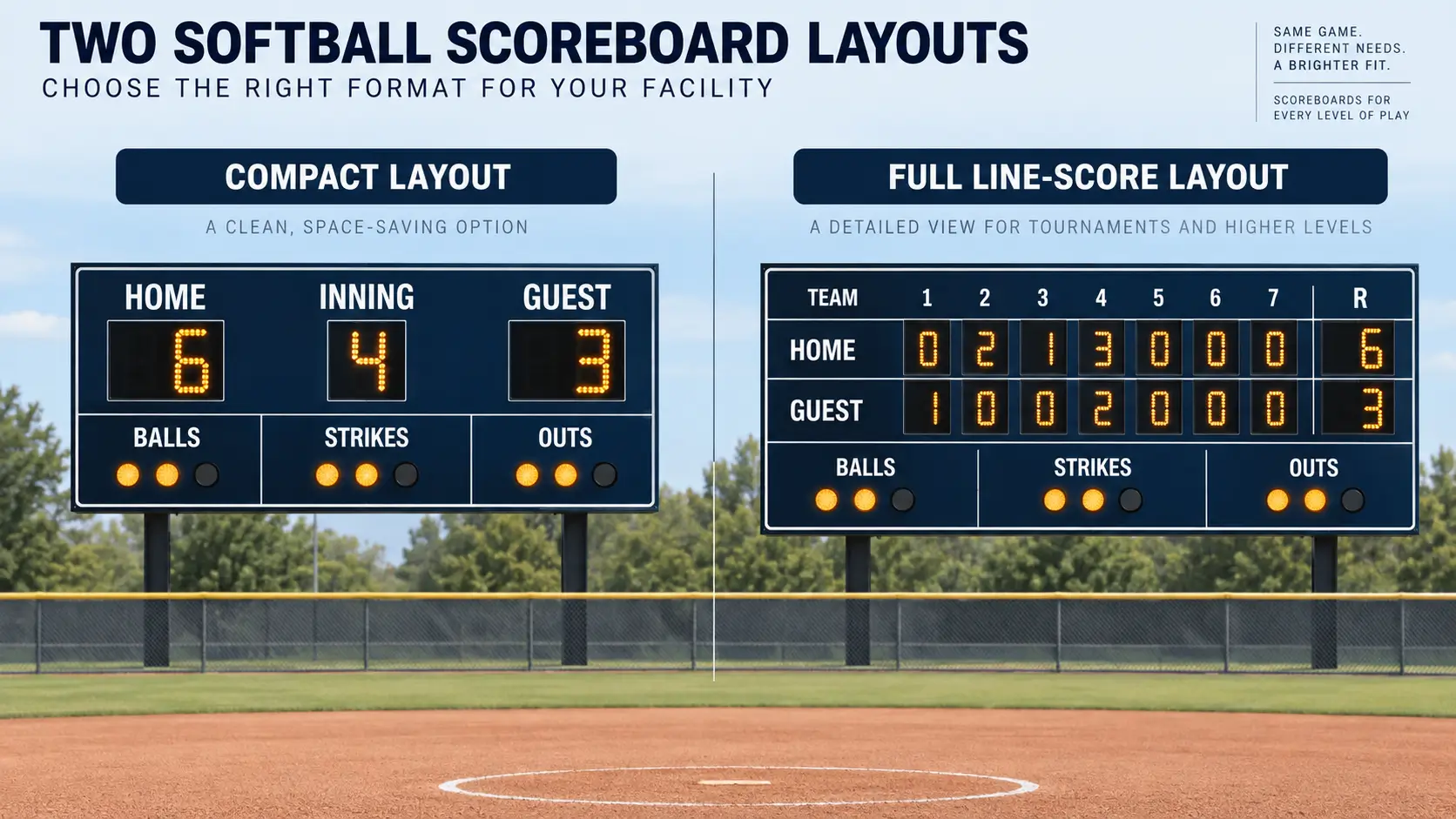
The best layout depends on what the audience needs to see during the game and how much space the field can support. A smaller board can make the core information easier to read, while a larger line-score layout can show more of the game’s history.

Compact Layout: Clear Information for Live Play
A compact layout focuses on the information that changes most often:
- HOME / GUEST scores
- INNING
- BALLS
- STRIKES
- OUTS
This format can suit practice fields, community leagues, youth games, and facilities with limited space. Because it uses fewer display areas, the score and count fields can remain prominent without making the cabinet unnecessarily large.
A compact layout may also simplify the installation. The support structure, power demand, cable route, and viewing area are easier to plan when the display has fewer columns and a smaller footprint.
Full Line-Score Layout: A Record of the Game
A full line-score layout adds runs by inning so spectators can see how the score developed, not only the current result.
This format can suit school competitions, tournaments, municipal fields, and venues that need a more formal presentation. It requires room for inning columns, team rows, current scores, and count fields. If the board is too small for all of these areas, the additional information can make the display harder to read from the stands.
Before choosing a full line-score layout, confirm how many inning columns the competition uses and where the board will be viewed from. The required fields and viewing distance should determine the cabinet size together.
Shared Baseball and Softball Layouts
If the venue hosts both baseball and softball, the layout can be planned around the fields required for both sports.
A baseball scoreboard may provide a useful reference for shared core fields. A multi-functional scoreboard may be considered when the venue needs different operating profiles or layouts.
This decision affects more than the face of the scoreboard. The controller should support the operating sequence for each sport, and the team names, captions, inning format, and optional fields may need to change between games.
A shared-use layout is most useful when the venue has a regular schedule for both sports. If the field is used mainly for softball, a layout designed around the primary game may provide clearer information and a simpler operating routine.
A Practical Layout Decision
Use this order when comparing layouts:
- Confirm the fields required by the competition.
- Measure the farthest regular viewing position.
- Check the available space beside or behind the field.
- Decide whether the venue needs baseball compatibility.
- Review the scaled layout before confirming the cabinet size.
The layout should be selected before the supplier finalizes the screen dimensions, support structure, controller profile, and quote.
How Can You Confirm Visibility and Installation Conditions?
A scoreboard can have the correct fields and still be difficult to use if the digits are too small, the display faces the afternoon sun, or the mounting position blocks part of the field. Confirm the viewing and installation conditions before the supplier fixes the screen size.

Choose Digit Height From the Farthest Regular Viewer
Choose digit height from the farthest position where spectators, coaches, or officials regularly need to read the board. Do not measure only from the scorer’s table or the nearest seating area.
Review the board from:
- The backstop;
- Regular seating;
- The farthest viewing position;
- One practical side angle.
The scaled drawing should show the cabinet dimensions, digit height, caption spacing, inning columns, optional fields, and viewing direction. This makes it easier to see whether the layout will remain readable after all required fields are added.
Check What Can Block or Wash Out the Display
Field conditions affect visibility as much as the LED display itself. Review the position of fencing, light poles, dugouts, covered seating, trees, nearby buildings, and the field orientation.
Afternoon sun can create glare on the display. Side viewing angles can make captions harder to read. A lower mounting position may place the board behind a fence or players. Field photos taken from several viewing points give the supplier more useful information than a product image alone.
Digit size is only one part of outdoor visibility. Contrast between the digits, captions, and background also affects readability in sunlight and from side angles. Ask the supplier to confirm how the proposed layout will remain readable under the field’s normal lighting conditions.
For an outdoor installation, confirm the cabinet’s weather protection, drainage, cable entry, and maintenance access. The required protection depends on the local weather and the mounting environment.
Match the Installation to the Site
A permanent scoreboard needs a support structure, power connection, cable route, grounding plan, weather protection, and maintenance access. These items should be reviewed together because changing the mounting position can affect the structure, wiring, viewing angle, and service method.
A semi-permanent scoreboard can suit a field that needs a more stable display but may need to remove or relocate the equipment later. Confirm the fence or wall condition, mounting points, power access, weather exposure, and future removal requirements.
A portable scoreboard requires a different check. Confirm the packed size, weight, wheels, storage location, transport route, weather exposure, and power access between fields.
Review the Drawing Before Production
Ask for a scaled layout before production begins. The drawing should show the scoreboard in relation to the diamond, fence, seating, lights, dugouts, and scorer’s position.
A review at this stage can reveal that the board needs a different aspect ratio, larger digits, fewer optional fields, or another mounting position. Making that decision before production is easier than correcting the structure after installation.

How Should You Confirm the Scoreboard Controller?
Confirm that the controller can update every required game field, correct mistakes, handle extra innings, and reset the board for the next game.
The operator should be able to update HOME and GUEST scores, change the INNING, update BALLS, STRIKES, and OUTS, and correct an entry without clearing other game information. Ask the supplier to demonstrate these actions in a normal softball game sequence.
A wired controller may suit a fixed scorer’s table or press box with a protected cable route. A wireless controller may suit a field where the operator needs to move. The operating range, interference conditions, and power arrangement should match the site.
What Should a Softball Scoreboard Quote Include?
A complete quote should identify the display layout, cabinet size, digit height, controller, mounting structure, power and cable work, delivery, installation, documentation, warranty, spare parts, and service support.
The final cost depends on the selected fields, display size, controller, support structure, electrical work, installation method, and site conditions. Portable, semi-permanent, and permanent systems may have different total costs because their structures, power arrangements, transport, and installation requirements differ.
Send the same layout and site information to each supplier so the proposals can be compared on the same basis. A display-only price does not show whether the complete system will fit the field or include the work required to install and operate it.
Prepare the Information for a Custom Proposal
Provide the competition type, required fields, viewing distance, field photos or a simple layout, mounting position, power information, and whether the venue also hosts baseball. You can also specify team names, sponsor panels, statistics, portable or permanent installation, and any existing support structure.
This information helps Comsight assess whether a standard softball layout, a baseball and softball configuration, or another custom LED scoreboard solution is suitable for the field.
How Should You Check the Scoreboard Before Handover?
Before accepting the scoreboard, confirm that the installed display matches the approved layout and that the main game actions work as expected.
Test the HOME and GUEST scores, INNING, BALLS, STRIKES, and OUTS. Correct one score, change the inning, and reset the board for the next game. View the display from the backstop, regular seating, farthest viewing position, and one practical side angle.
Keep the approved layout, controller instructions, warranty terms, and service contact for future use.
Conclusion
The right softball scoreboard begins with the information the game requires. For most fields, the general layout includes HOME, GUEST, the current score, INNING, BALLS, STRIKES, and OUTS. HITS, ERRORS, inning-by-inning scores, team names, sponsor panels, and other statistics can be added when the competition or facility needs them.
The layout should then match the field. A compact board can keep the core information clear. A full line-score board can show how the score developed. A shared baseball and softball layout can support both sports when the venue needs that flexibility.
Viewing distance, sunlight, mounting, power, controller operation, and service access all affect the final proposal. Provide these details before comparing quotes so each supplier is working from the same project requirements.
If you are planning a new softball scoreboard, send Comsight the competition details, required fields, field photos, viewing distance, and installation information. The team can review whether a standard layout, a baseball and softball configuration, or another custom outdoor LED scoreboard solution fits the field.
FAQs
1. What Is the Difference Between a Softball and Baseball Scoreboard?
The core fields can be similar, including HOME, GUEST, score, INNING, BALLS, STRIKES, and OUTS. The final layout should follow the competition, field requirements, and whether the venue hosts one sport or both.
2. Do All Softball Scoreboards Need a Full Line Score?
No. A compact layout may be enough when spectators only need the live score, inning, and count fields. A full line-score layout is more suitable when the venue needs runs by inning.
3. Is a Portable Scoreboard Suitable for Every Softball Field?
Not always. A portable system may suit practice fields, temporary events, or venues that move equipment between fields. A permanent installation may be more suitable for a dedicated field with regular competitions.
4. What Makes a Softball Scoreboard Easy to Read Outdoors?
Digit height, viewing distance, contrast, sunlight, viewing angle, mounting position, and surrounding obstructions all affect readability. The supplier should review the field conditions before confirming the layout.
5. Can a Softball Scoreboard Support Different Competitions?
It can be configured with different fields or operating profiles when the controller and layout support them. Confirm the league requirements, optional statistics, inning format, and reset process before production.
6. Can a Softball Field Use the Same Scoreboard for Baseball?
It can be planned for shared use when the venue regularly hosts both sports. The display fields, captions, controller functions, and layouts should be confirmed for both game formats.
7. What Should I Prepare Before Contacting a Scoreboard Supplier?
Prepare the competition type, required fields, viewing distance, field photos or a site plan, mounting position, power information, and whether the scoreboard must also support baseball. These details help the supplier recommend a suitable layout and quote scope.

