


The World Cup is almost impossible to scroll past right now. The group-stage smoke has barely cleared, and the knockouts are already doing what knockouts do best: lifting one country into a street party and sending another home in silence. Canada found a stoppage-time winner. Mexico lit up the Azteca with a night that will be replayed for years.
Now imagine those moments in your city square, shopping plaza, hotel terrace, beer garden, or stadium fan zone. Some fans are near the front, flags in the air. Others are stuck near the back, trying to see over shoulders. When the shot bends toward the top corner, everyone should be able to see it.
A screen can lift or flatten the event. If it is too small, too dim, or badly placed, fans hear the roar before they understand what happened. Outdoor LED screens help you keep the match visible for the whole crowd, with the brightness, size, viewing distance, and shared focal point that phones, small TVs, and many outdoor projection setups cannot offer.
This guide explains how outdoor LED screens improve World Cup fan zones and public viewing events, which screen features affect the viewing experience, and how you can choose a display that still creates value after the final whistle.
What Are World Cup Fan Zones and Public Viewing Events Like?
World Cup fan zones and public viewing events are shared match-watching spaces for fans who want the stadium feeling without being inside the stadium. Because let’s be honest, not everyone can get a World Cup ticket. Some fans miss the ticket window. Some lose the online queue. Some take one look at travel costs and decide the city square suddenly looks pretty good.
They can be large city events, commercial plaza screenings, hotel terrace parties, beer garden nights, school events, or sponsor-led football activations.
The scale can change a lot. A city fan zone may include a main stage, food trucks, security lanes, crowd barriers, brand booths, and one or more large outdoor LED screens. A shopping mall may use an outdoor plaza with a screen, audio system, brand booths, and halftime promotions. A hotel or restaurant may create a smaller premium viewing area for guests.
What they all have in common is the same basic job: bring many people around one match and make the event feel bigger than a normal broadcast.
For you as an organizer, the screen is more than a place to show the game. It supports the whole event flow.
Before kickoff, it can show countdowns, team lineups, sponsor content, and event rules. During the match, it keeps everyone focused on the action. At halftime, it can switch to ads, crowd shots, food offers, or live host segments. After the final whistle, it can guide people toward exits, transport, parking, or the next activity.
The same idea applies to scoreboards: LED scoreboards enhance the sports viewing experience by making live scores, replays, crowd prompts, and sponsor content easier to follow.
In a World Cup fan zone, the match brings people in. The screen helps keep them there.
How Do Outdoor LED Screens Improve the Match-Watching Experience?
Outdoor LED screens improve World Cup public viewing by making the match easier to see, easier to follow, and easier to share with a crowd. Better brightness helps fans see the game in daylight. Better contrast and grayscale help the pitch, shirts, shadows, and broadcast graphics look more natural. The right pixel pitch helps people read the score and follow player movement from the right distance.
Fans want to see more than a moving ball. They want the first touch, the passing lane, the goalkeeper’s reach, the offside line, and the replay that starts the argument all over again.
Screen Size
A TV may work for a small patio, but it cannot carry a plaza. Fans at the back may see only a bright rectangle instead of the match. A large LED screen gives the crowd a clear focal point, so people do not have to push toward the front just to understand what happened.

Brightness
World Cup kickoff times do not always wait for perfect viewing conditions. Some matches may happen in daylight, early evening glare, or shifting outdoor light. Projection can work in a dark room or a shaded evening setup, but daylight can wash out the picture. Outdoor LED screens use direct light from LED modules, so the image can stay brighter and easier to read outdoors.
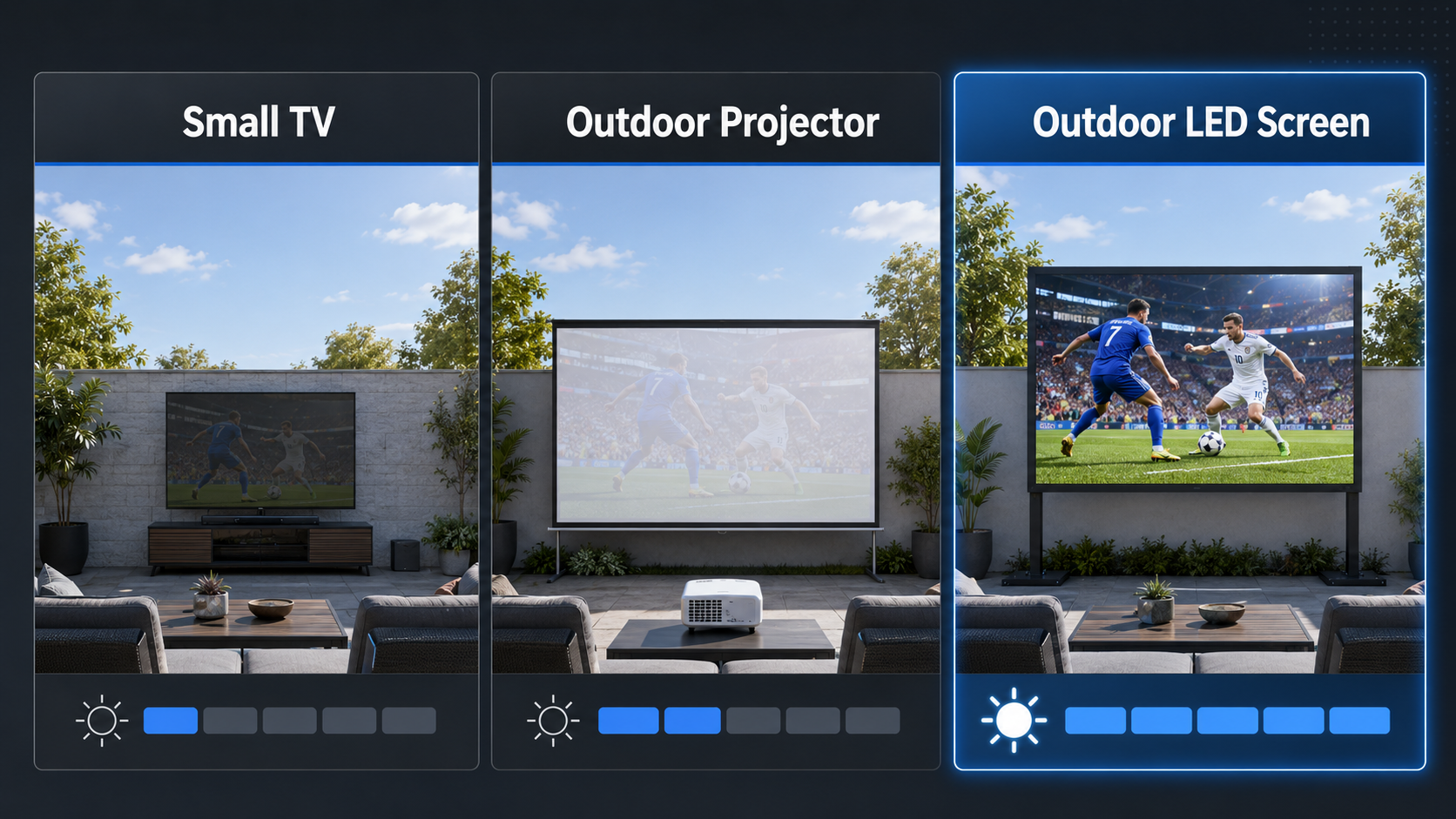
Image Quality
Football is full of fast, small details: shirt colors, grass texture, player movement, score graphics, and close-up reactions. Strong contrast, high grayscale, good color performance, and high refresh performance help those details stay clear instead of looking flat, faded, or blurry.
Pixel Pitch
Pixel pitch affects how sharp the screen looks from different distances. A finer pitch helps closer viewers see faces, text, and broadcast graphics more clearly. A larger pitch can still work well when most fans watch from farther back. The right choice depends on the closest viewing distance, main crowd area, screen height, and content type.
Content Control
A public viewing screen should do more than show the live feed. You can use it for lineups before kickoff, sponsor ads before halftime, replays after key moments, food and drink offers during breaks, and safety messages when the crowd needs direction.
Comsight can support this planning with customizable outdoor digital billboard and public viewing display solutions. Depending on the project, that may include custom screen size, selectable pixel pitch, outdoor high-brightness display design, high contrast, high grayscale, high refresh performance, cabinet customization, control system support, and front-access maintenance options.
Those are not just technical labels. They affect what fans actually see and how smoothly you can run the event. A well-planned screen helps fans outside the stadium follow the same moment together, whether they are near the front, waiting for food, standing off to the side, or watching from the back of the plaza.

How Do You Choose Screen Size and Pixel Pitch for the Crowd?
Choose screen size and pixel pitch by looking at your public viewing area first. Do not start with “P4 or P6?” Start with a simpler question: where will fans stand, and how far are they from the screen?
For a World Cup fan zone, beer garden, shopping plaza, hotel terrace, or city square, the crowd is rarely in one neat row. Some people stand close to the screen. Some watch from the middle of the space. Some drift toward food lines, side areas, or the back of the plaza. Your screen needs to serve the real crowd layout, not an ideal drawing.
Start by collecting 5 basic details:
- Screen Location: Where can the screen safely stand or mount?
- Closest Viewing Distance: How close can fans stand without blocking access or creating crowd pressure?
- Main Viewing Area: Where will most people watch the match?
- Farthest Useful Viewing Point: How far back do you still want people to follow the game?
- Content Type: Will the screen show only live match video, or also scores, ads, schedules, and safety messages?
Screen size affects how far the match can carry. A small screen may look fine near the front, but fans farther back may lose the score graphic, player close-ups, and replay details. For public viewing, the screen should be large enough for people to follow the game without pushing into one tight viewing pocket.
LED pixel pitch affects how sharp the image looks at different distances. A smaller pixel pitch gives sharper detail for closer viewers. A larger pitch can still work well when most fans stand farther back, because the eye blends pixels at distance.
The best choice is not always the finest pitch. If your crowd is mostly far from the screen, extra resolution may add cost without improving what fans actually see. If your crowd stands close, a pitch that is too large can make faces, score graphics, and sponsor text look rough.
Use this as an early planning reference:
Pixel Pitch | Better Fit For |
P2.9 to P4 | Close viewing areas, VIP terraces, compact plazas |
P4 to P6 | Medium public viewing areas, shopping plazas, hotel outdoor spaces |
P6 to P10 | Larger open areas where most fans watch from farther back |
Screen height also affects viewing reach. A rough planning method is that the farthest viewing distance can be about 30 times the screen height under suitable site conditions. For example, a 4-meter-tall screen may support viewing from around 120 meters if the site layout, mounting height, and sightlines are suitable.
You also need to think about what fans must read on the screen. Live match footage needs smooth motion. Scores and match clocks need clear text. Sponsor ads need stable color and readable logos. Safety messages need simple layouts that people can read quickly while moving through the public viewing area.
If you are not sure which screen size or pixel pitch fits your site, send us your basic project details: site size, screen location, closest and main viewing distance, estimated crowd area, installation method, and content needs. Comsight can help you plan custom LED display with suitable screen size, pixel pitch, cabinet design, control options, and front-access maintenance, so your team does not have to piece the system together one part at a time.

How Can an Outdoor LED Screen Keep Working After the World Cup?
An outdoor LED screen does not have to be a one-month World Cup expense. If you choose the right setup, the same screen can support sports nights, retail campaigns, public events, seasonal promotions, and daily advertising after the tournament ends.
The World Cup may be the reason you start the project. It brings the crowd, the timing, and the sense of urgency. But once the screen is in place, you can use it for much more than match broadcasts.
- For a shopping plaza, the display can move from live football to restaurant offers, retail promotions, holiday campaigns, brand videos, and weekend event schedules.
- For a hotel terrace, bar, or beer garden, it can support live sports, outdoor movie nights, music events, private bookings, and seasonal offers.
- For a city square or community viewing area, the screen can support festivals, concerts, public notices, weather alerts, cultural programs, and other shared broadcasts. A good screen does not sit idle just because the final whistle has blown.

Long-term outdoor LED signs for business setup can also support advertising, brand campaigns, and public information after the World Cup, especially in sites with regular foot traffic.
This is why durability and maintenance deserve attention early. A screen that stays after the World Cup needs more than size and brightness. It also needs weather protection, stable control, serviceable cabinet design, and a maintenance plan that does not make every repair painful.
Comsight’s confirmed strengths fit this kind of long-term use: custom cabinet structures, selectable pixel pitch, front-access maintenance for cabinets and modules, tool-free access, brightness adjustment, status monitoring, LED fault detection, thermal management, N+1 redundant power backup, and CSTCloud control options.
You do not need every feature for every project. A small hotel terrace and a large city square will not need the same system. But it helps to decide early whether the screen is temporary, semi-permanent, or permanent. Share what you want to show after the World Cup, and your supplier can plan the display around both the tournament rush and the quieter months that follow.
How Can Comsight Support Outdoor LED Screen Projects?

Comsight can support World Cup fan zone and public viewing projects by helping you match the LED display to the real site, crowd distance, content plan, and long-term use. The goal is to build a screen system that works for match day and still makes sense after the tournament.
Since 2001, Comsight has focused on LED display systems for outdoor signs, digital billboards, sports scoreboards, transportation displays, and custom LED solutions. For public viewing projects, that experience helps when your screen needs to handle daylight, weather, live video, sponsor content, and future advertising or event use.
Comsight has built experience across both outdoor LED display systems and video wall projects, which is exactly the mix a World Cup public viewing screen needs. In Saudi Arabia, Comsight supplied nearly 450sqm of outdoor LED displays for national sports venues, where heat dissipation, outdoor stability, display visibility, and centralized monitoring all had to be considered from the start. We have also worked on video wall projects where image quality, content playback, and control reliability shape the viewing experience.
For your World Cup fan zone, public plaza, hotel terrace, beer garden, or commercial viewing area, you do not have to start from a blank sheet. Send us your site size, viewing distance, screen location, installation method, content plan, and whether the screen will stay after the tournament. Comsight can help you plan the outdoor LED screen as a complete display system, from pixel pitch and cabinet structure to control, maintenance, and long-term use.
Conclusion
The World Cup gives you the crowd, the emotion, and the reason to bring people together. A well-planned outdoor LED screen helps you carry that energy across the whole public viewing area, so fans can see the match clearly, follow every key moment, and stay connected before kickoff, during halftime, and after the final whistle.
For a fan zone, shopping plaza, hotel terrace, beer garden, or city square, the screen should not be chosen only by size or price. Brightness, pixel pitch, viewing distance, image quality, installation method, control options, and maintenance access all affect how the event feels on match day and how useful the screen remains after the tournament.
If you are planning an outdoor LED screen for a World Cup public viewing event, send Comsight your site details, crowd layout, viewing distance, content needs, and long-term use plan. We can help you choose a display setup that works for the excitement of the World Cup and keeps creating value long after the final whistle.
FAQs
1. Should you choose a rental LED screen or a permanent outdoor LED display?
Choose rental if the screen is only needed for a short fan event and the site will not use it after the tournament. Choose a permanent outdoor LED display if the location has regular foot traffic, advertising needs, retail campaigns, sports nights, or public events after the World Cup. The better choice depends on how long the screen will stay, how often you will use it, and whether the site can support a fixed installation.
2. How early should you start planning an outdoor LED screen for a World Cup viewing event?
Start as early as possible, especially if the screen needs a custom size, outdoor structure, control system, shipping, installation, and on-site testing. A simple temporary setup may move faster, but a permanent or semi-permanent outdoor LED display needs more planning. You should leave time for site checks, power planning, structural review, content testing, and weather-related installation delays.
3. What power and signal setup should you prepare for an outdoor LED screen?
You need to confirm the available power supply, cable route, control room or media source, network access, and backup plan. Outdoor LED screens also need safe cable protection, grounding, waterproof connection points, and enough space for control equipment. If the event will show live match video, test the signal chain before match day so the screen, audio, broadcast source, and control system work together.
4. Do you need one main LED screen or additional side screens?
One main LED screen may be enough for a compact viewing area with clear sightlines. Larger plazas, long streets, crowded food areas, or spaces with obstacles may need side screens or secondary displays. The question is not only how many people will attend. It is where they will stand, where they will move, and whether they can still follow the match without pushing into one crowded area.
5. What should you send to Comsight before asking for a proposal?
Send your site size, screen location, closest and farthest viewing distance, estimated crowd area, installation method, event schedule, content type, local weather conditions, and whether the screen will stay after the World Cup. Photos, drawings, or a simple site map are also helpful. With those details, Comsight can recommend a more suitable outdoor LED display plan instead of giving you a generic screen size.

